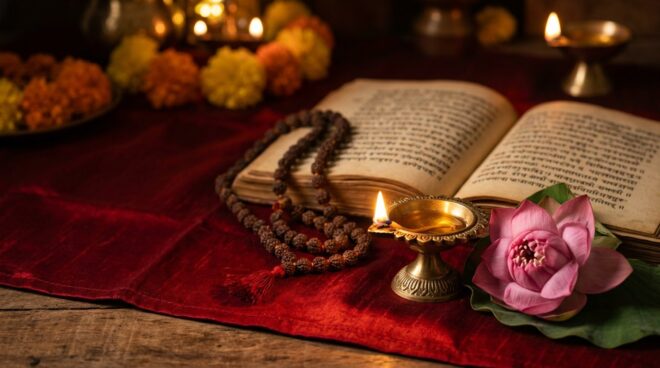
In most of our homes, Diwali puja is run by Nani or Dadi. She sits cross-legged in front of the mandir, rattles off one mantra after another without opening a book, and the rest of us mumble along half a beat late. Be honest, you probably only know the first line of most of them too. The tune sticks though. You hear it in your head the minute somebody lights a diya.
Puja at home this year and the words feel a bit shaky? Same here, every single year. Below you’ll get each mantra in Devanagari, then in English letters so you can read it off your phone, then a rough idea of what you’re actually saying and when in the puja it comes. No pandit needed. A clean corner, one diya, ten quiet minutes. That’s it really.
When is Lakshmi Puja this year?
Diwali is on Sunday, November 8, 2026. In New Delhi the Lakshmi Puja muhurat is 5:54 PM to 7:50 PM, inside the Pradosh Kaal of 5:31 PM to 8:09 PM (Drik Panchang). The timing shifts a little from city to city:
- New Delhi: 5:54 PM to 7:50 PM
- Gurgaon: 5:55 PM to 7:51 PM
- Chandigarh: 5:52 PM to 7:46 PM
- Jaipur: 6:03 PM to 7:59 PM
- Kolkata: 5:20 PM to 7:18 PM
- Mumbai: 6:27 PM to 8:27 PM
- Pune: 6:24 PM to 8:24 PM
- Ahmedabad: 6:22 PM to 8:20 PM
- Hyderabad: 6:07 PM to 8:08 PM
- Chennai: 6:07 PM to 8:09 PM, near enough the same as Hyderabad
- Bengaluru: 6:17 PM to 8:20 PM, so Bangalore folks get an extra 20-odd minutes over Delhi
Doing Dhanteras puja too? That’s Friday, November 6, and Delhi’s window that evening runs 6:02 PM to 7:57 PM.
A few things before you begin
Have a bath first and put on something fresh. In a lot of homes that means the new kurta, and nobody touches the mithai till the puja’s done. Sit facing east or north if you can, on an asan or even a folded dupatta rather than the cold floor.
Light your diya, and start with Ganesh ji. Every puja does, whichever god or goddess it’s really for. If you own a mala, the usual count is 108. Don’t own one? Do 11, or 21, and don’t sweat it. As the elders say, Lakshmi ji isn’t counting, she’s listening. And pronunciation? Just go slow. Nobody’s grading you, least of all Lakshmi ji.
1. Ganesh mantra (always first)
वक्रतुण्ड महाकाय सूर्यकोटि समप्रभ।
निर्विघ्नं कुरु मे देव सर्वकार्येषु सर्वदा॥
Vakratunda Mahakaya Suryakoti Samaprabha, Nirvighnam Kuru Me Deva Sarva Karyeshu Sarvada.
Basically you’re telling Bappa, big belly, bent trunk, shining like a crore suns and all, please don’t let anything get stuck this year. This one opens the puja. Nothing comes before it.
ॐ गं गणपतये नमः
Om Gam Ganapataye Namah.
Just “I bow to Ganapati.” Because it’s so short, this is the one people usually run through on a mala.
2. The main event: Om Shreem Hreem
ॐ श्रीं ह्रीं श्रीं कमले कमलालये प्रसीद प्रसीद।
श्रीं ह्रीं श्रीं ॐ महालक्ष्म्यै नमः॥
Om Shreem Hreem Shreem Kamale Kamalalaye Praseed Praseed, Shreem Hreem Shreem Om Mahalakshmyai Namah.
Kamale, kamalalaye, lotus girl, lotus home. Then praseed praseed, which is you saying “please be happy with us” twice because once doesn’t feel like enough. This is the big one of the evening. Say it inside the muhurat, once the flowers and kumkum have gone up.
3. Short Lakshmi beej mantra
ॐ श्रीं महालक्ष्म्यै नमः
Om Shreem Mahalakshmyai Namah.
“Shreem” is her beej, or seed, sound, and the rest is just a bow to the great Lakshmi. You can say it any time over Dhanteras and Diwali. Kids pick it up in about two minutes flat, so get them to join in.
4. Lakshmi Gayatri mantra
ॐ महालक्ष्म्यै च विद्महे विष्णुपत्न्यै च धीमहि।
तन्नो लक्ष्मीः प्रचोदयात्॥
Om Mahalakshmyai Cha Vidmahe, Vishnu Patnyai Cha Dheemahi, Tanno Lakshmih Prachodayat.
Same shape as the famous Gayatri, just pointed at Lakshmi ji, Vishnu ji’s wife. It asks her to push our thinking the right way. Families tend to say it after the main puja, while somebody’s getting the aarti thali ready.
5. Kuber mantra for Dhanteras
ॐ यक्षाय कुबेराय वैश्रवणाय धनधान्याधिपतये
धनधान्यसमृद्धिं मे देहि दापय स्वाहा॥
Om Yakshaya Kuberaya Vaishravanaya Dhanadhanyadhipataye, Dhanadhanya Samriddhim Me Dehi Dapaya Swaha.
Kuber is king of the Yakshas and the treasurer of the gods, and here you’re straight-up asking him for money and grain, enough of both. Dhanteras evening is his time. Lots of business families repeat it on Diwali night too.
6. For everyone’s health: Om Namo Bhagavate
ॐ नमो भगवते वासुदेवाय धन्वन्तरये अमृतकलशहस्ताय
सर्वामयविनाशनाय त्रैलोक्यनाथाय श्रीमहाविष्णवे नमः॥
Om Namo Bhagavate Vasudevaya Dhanvantaraye Amrita Kalasha Hastaya, Sarvamaya Vinashanaya Trailokya Nathaya Shri Mahavishnave Namah.
Think of Dhanvantari as the gods’ own vaid ji, Vishnu with a kalash of amrit in hand. Fun bit: Dhanteras has another name, Dhanvantari Trayodashi, because it’s his jayanti. So with all the gold-buying, slip this one in for Mummy-Papa’s knees and BP too.
7. Deepak mantra (when you light the diya)
शुभं करोति कल्याणम् आरोग्यं धनसम्पदा।
शत्रुबुद्धिविनाशाय दीपज्योतिर्नमोऽस्तु ते॥
Shubham Karoti Kalyanam Arogyam Dhanasampada, Shatru Buddhi Vinashaya Deepa Jyotir Namostute.
A salute to the lamp’s flame, for bringing luck, health and money and burning away bad thoughts. Say it as you light diyas on Diwali night. Plenty of homes in Maharashtra and Karnataka don’t wait for Diwali, they say it every single evening at sandhya time.
8. Saraswati mantra for students and business books
ॐ ऐं सरस्वत्यै नमः
Om Aim Saraswatyai Namah.
A bow to Saraswati, goddess of learning. Why’s she here on Diwali? Plenty of families keep all three idols together on Diwali. And go to any old Chandni Chowk shop that night, you’ll see the lala ji doing Sharda Puja over a fresh red bahi-khata. Get the kids to put their schoolbooks near the mandir and say this one.
A simple order for the puja at home
Nothing fancy. Diya first, with the Deepak mantra. Then Ganesh ji, a bit of durva or one flower. Then the main part: kumkum, chawal, flowers and the mithai go to Maa Lakshmi while you say the Om Shreem Hreem one. Kuber and Saraswati if that’s your family’s custom, Lakshmi Gayatri to wrap up, and then everyone stands for “Om Jai Lakshmi Mata”. One diya stays lit by the front door all night. Someone has to keep topping up the oil, usually the youngest.
Questions people usually ask
Can women and children chant these mantras?
Yes. In most homes it’s the women running the whole puja anyway. Kids tend to manage the short ones best, like the Shreem one.
Is 108 times a must?
Nope. 108 goes with a mala. 11 or 21 said properly is completely fine.
Stuck in traffic and missed the muhurat?
Happens to half of Delhi every year. Just do it the moment you’re home. The Amavasya tithi lasts until 12:31 PM on November 9, and the Pradosh Kaal muhurat is the preferred window, not the only one.
Wishing you a peaceful Lakshmi Puja. If you’re looking for something to send the family afterwards, I’ve put together Diwali 2026 wishes and messages with WhatsApp images.