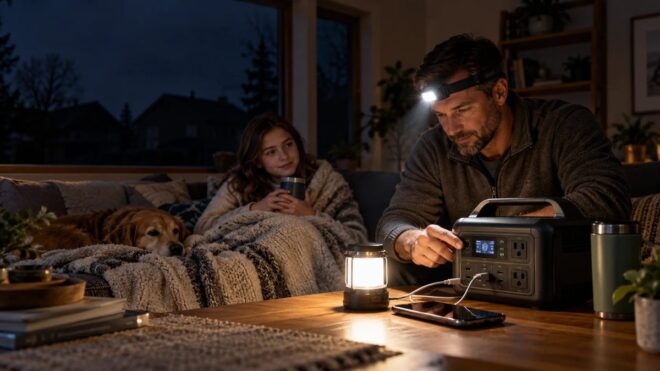
So the lights go out right as you’re plating dinner. Of course they do. The fridge goes quiet, the Wi-Fi’s gone, and almost immediately somebody wants to know if the car charger still works.
Here’s the good news: nobody expects you to have it all sorted in the first five minutes. What you actually need is enough light to get around without tripping over things, some way to hear what’s going on, and a plan for anyone in the house who needs power for medical gear. The freezer? Leave it. Honestly, keeping that door shut is about the smartest thing you can do for it right now.
What I’ve put together below is basically the order I’d go through things in on that first night, and while the bits about food temperatures and generators follow the official U.S. recommendations, your local utility or emergency management office gets the final word, so if they’re telling you something different, listen to them.
First 10 Minutes: Don’t Overthink It
People come first and the appliances can wait. If somebody in your home relies on powered medical equipment, switch them over to their backup plan right away, and if there’s no way for them to keep up their treatment without power, call for help.
After that, try to work out how big this thing is. Peek outside. Are the neighbors still lit up? If your phone has signal, pull up your utility’s outage map. You can open the breaker panel, but only if the area around it is dry and nothing looks damaged, and don’t ever take the cover off.
Now go around and switch off the stove, the oven, space heaters, the AC, and whatever else might kick back on by itself while nobody’s watching and cause trouble. The computers, the TV, the game console and anything else that’s a bit delicate can get unplugged too, as long as you can reach the plugs without putting yourself in a bad spot. Oh, but leave one light switched on. Otherwise how are you going to know when the power’s back?
Fridge and freezer? Shut. Then scribble down what time everything went dark (you’ll want that later) and tell the utility about it. Use their app, the website, their text thing, or just call the outage number, whatever they’ve got. And please don’t call 911 over this unless it’s turned into an actual emergency.
Downed lines are a different story. Keep well back from them and from anything they’re touching, and report them from a safe distance. A street that’s gone completely dark can still have a live wire lying in it, so don’t assume a fallen one is dead just because the lights are out everywhere.
Fridge and Freezer: The 4-Hour and 48-Hour Rules
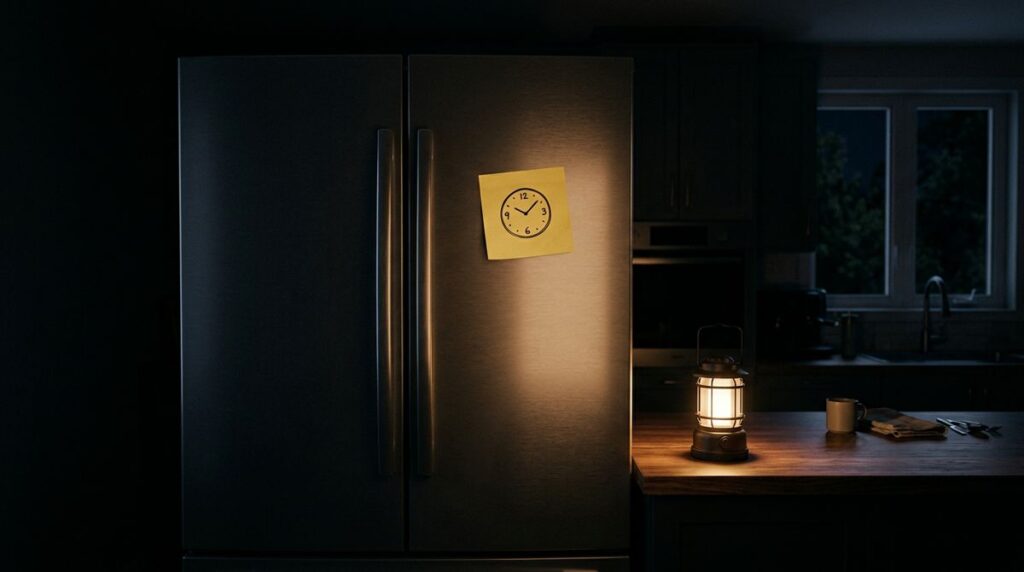
Look, I know it feels like you’re being responsible every time you crack the fridge open to see how it’s holding up, but all you’re really doing is letting the cold spill out onto the kitchen floor, and that shortens the window you’ve got before things turn unsafe.
Keep the doors shut and here’s more or less what you’re working with:
- your fridge will usually stay safe for about 4 hours
- a freezer that’s packed full can go somewhere around 48 hours
- if it’s only half full, figure it’s closer to 24 hours
Those are rough numbers to plan around, and nobody’s guaranteeing them, since it depends on how cold the thing was when the power cut out, how well it’s insulated, how warm the room is and how often somebody keeps pulling the door open.
One thing that trips people up is that four hours without power isn’t the same as four hours sitting above 40°F (about 4°C). If you can’t actually show that the perishable stuff stayed cold enough, throw it out once you hit four hours without power, and please, please don’t taste it to “check.”
The stuff that generally has to go if it sat above 40°F for more than two hours:
- meat, poultry, fish, eggs, and whatever leftovers were in there
- milk, yogurt, and soft or shredded cheese
- cut fruit or veggies, plus cooked rice and pasta
- any creamy dressing or spaghetti sauce you’d already opened
What you can usually keep:
- hard cheeses, so your block of Cheddar or the Parmesan
- butter and margarine
- ketchup, mustard, pickles and those vinegar-based dressings
Plenty of frozen food is fine to refreeze too, as long as there are still ice crystals in it or it never got warmer than 40°F.
Lighting That Doesn’t Drain Your Phone
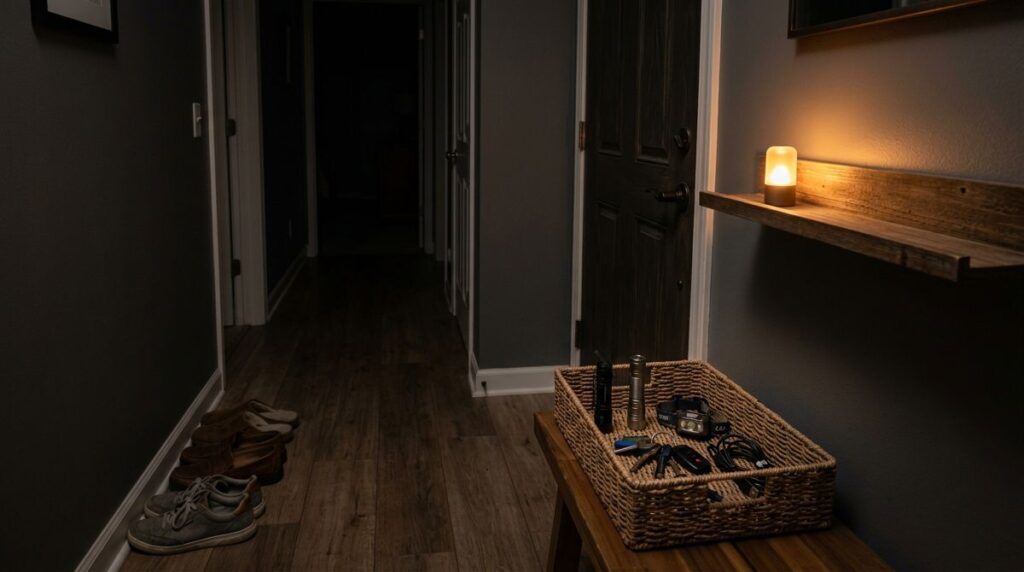
Your phone’s flashlight is great for one job: finding your real flashlight. Leave it running all evening and you’re burning through battery you might want later for calls or news.
If you can, give everybody their own light. Headlamps are brilliant because your hands stay free. Put an LED lantern in whatever room everyone ends up hanging out in, and stick a little battery light in the hallway so middle-of-the-night bathroom runs aren’t an obstacle course.
Candles? I’d skip them. Battery lights are just safer.
One habit that really does pay off is keeping flashlights, keys, shoes and charging cables all in one spot. Stumbling from one dark room to the next looking for them gets old really fast.
Backup Power: Match the Gear to What You Actually Need
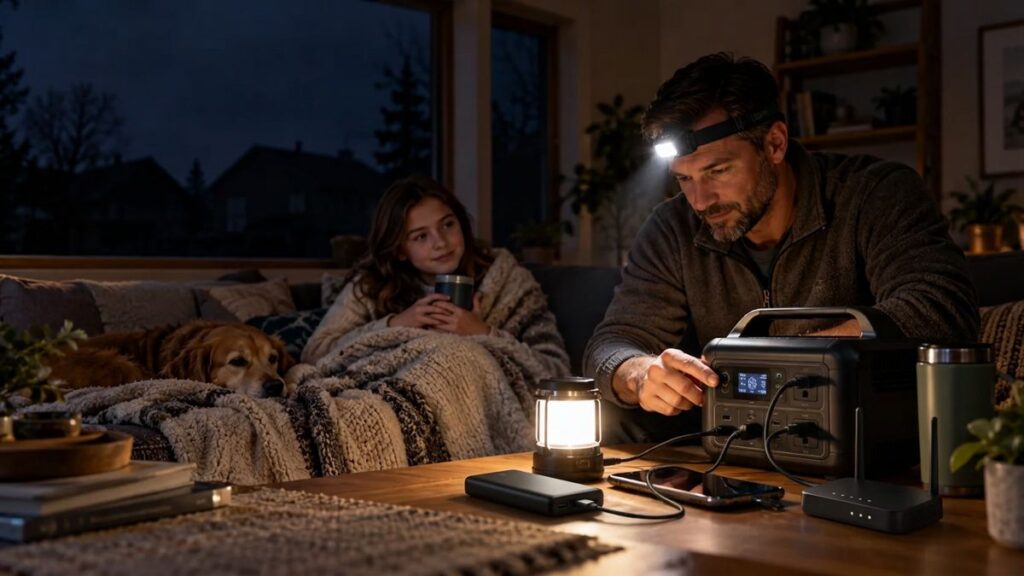
Before you go buying anything, or digging old gear out of the closet, sit down and make a list of the things that genuinely can’t go without power, like your phone, one lamp, a fan, a medical device that has an approved backup, and so on.
You really only need to get your head around two numbers here:
- watts (W), which is how much power something’s pulling at any one moment
- watt-hours (Wh), which is how much energy is actually sitting in the battery
A battery can be packed with energy and still let you down if its inverter is too small to get your fridge started. Flip it around and a huge inverter can drain a small battery in no time.
USB power banks are fine for phones and small lights. If you’ve got a 10,000 mAh pack rated at a nominal 3.7 V, that works out to roughly 37 Wh before losses, and a 20,000 mAh one is about 74 Wh. Now say your phone has a pretty typical 15 Wh battery and about 75% of what’s in the pack actually ends up in the phone, and you’re looking at roughly 1.8 full charges from the smaller pack and about 3.7 from the bigger one. Use the phone while it’s charging and those numbers drop. Also, to be clear, that’s just math, not lab testing on any particular product.
Running an inverter off your car battery is doable if you’ve got the right equipment and you don’t push past what the vehicle’s built to handle. What the inverter does is take the DC power from the battery and turn it into the same kind of AC you get from a wall outlet at home, but its voltage, frequency and waveform still have to suit whatever it is you’re planning to plug into it.
Most people end up doing it in one of two ways:
- the accessory socket (cigarette lighter / 12V outlet), in which case you’ll want to dig out the owner’s manual and find its rating, because there isn’t some universal 150 W limit and every manufacturer sets its own. You also lose a bit in the conversion, so less AC comes out than the socket can supply, and honestly, if it’s just phones or laptops, a USB charger that’s approved for your vehicle is often the simpler way to go.
- hooking straight into the battery, which means proper cables, secure terminals, and a fuse that’s sized for the job and sits close to the positive terminal. Generic alligator clips aren’t a safe shortcut once the loads get bigger. The current gets big fast, too, since a 1,000 W load at 12 V and ~85% efficiency is pulling nearly 100 A, and at that level a sloppy connection or a cable that’s too thin turns into a real problem. My advice is to have an automotive electrician set up any high-current connections for you long before you’re stuck needing them in an emergency.
On paper a 12 V, 60 Ah starting battery holds 720 Wh, but there’s no safe way to use all of that, because you’ve got to leave enough in there to get the engine going again afterward. Its age, the temperature, its general condition and how fast you’re draining it all cut into what’s usable. An inverter’s low-voltage cutoff won’t promise the car starts afterward, either. And no, there isn’t some dependable “idle ten minutes every hour” rule that works on every vehicle.
If your manufacturer says it’s okay to run an inverter with the engine on, keep the car outside and well away from doors, windows and vents. Never inside a garage, not even with the door open. With hybrids and EVs, stick to whatever power-export system the manufacturer has approved, and don’t go improvising your own hookup to their high-voltage systems, ever.
Portable power stations are basically the battery, the charging electronics and the outlets all bundled into one box, and before you buy one it’s worth checking how much it can put out continuously, whether it can handle starting a motor, how much of its capacity you can actually use and how on earth you’re going to recharge it. If you want a rough idea of how long one will last, the math goes like this:
Runtime ≈ (battery Wh × usable fraction) ÷ average load in watts
So with a 500 Wh station where you can use ~80% of it (~400 Wh), you’d get something like:
- 5 W LED lamp → ~80 hours
- 20 W router + modem → ~20 hours
- 30 W fan → ~13 hours
- 60 W laptop → ~6–7 hours
- fridge averaging 50 W → ~8 hours
Those are just examples, not specs for any real appliance. Keep in mind a fridge also needs enough startup power to kick its compressor on, and the inverter’s standby draw takes a bite out of runtime too. Oh, and keeping the router alive won’t do much if your internet provider’s network is down as well.
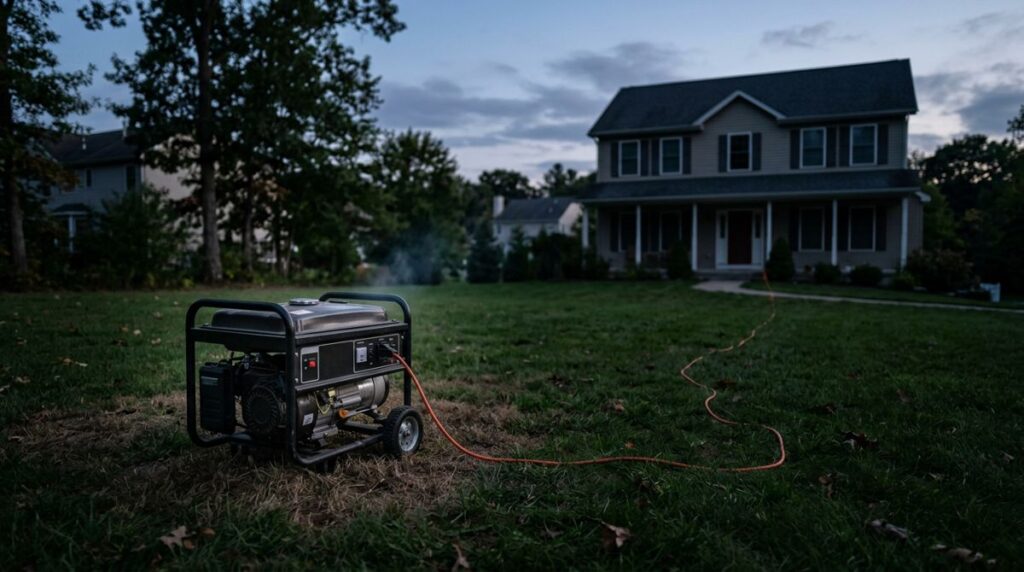
Fuel generators have to run outside, well away from doors, windows and vents. A garage, an enclosed balcony or an open carport doesn’t count as safe. Plug your stuff directly into the generator’s outlets using properly rated cords. Want it to power circuits in the house? Then a qualified electrician needs to put in a proper transfer system. Now, the big one. People sometimes plug a generator straight into a wall outlet or the dryer outlet, and that’s called “backfeeding.” Never, ever do it. It can energize the utility lines and put the line workers out there in serious danger, and no, a male-to-male cord doesn’t make it okay, so never use one for this. Last thing: when it’s time to refuel, turn the generator off and let it cool down first.
Water, Toilets, and Temperature
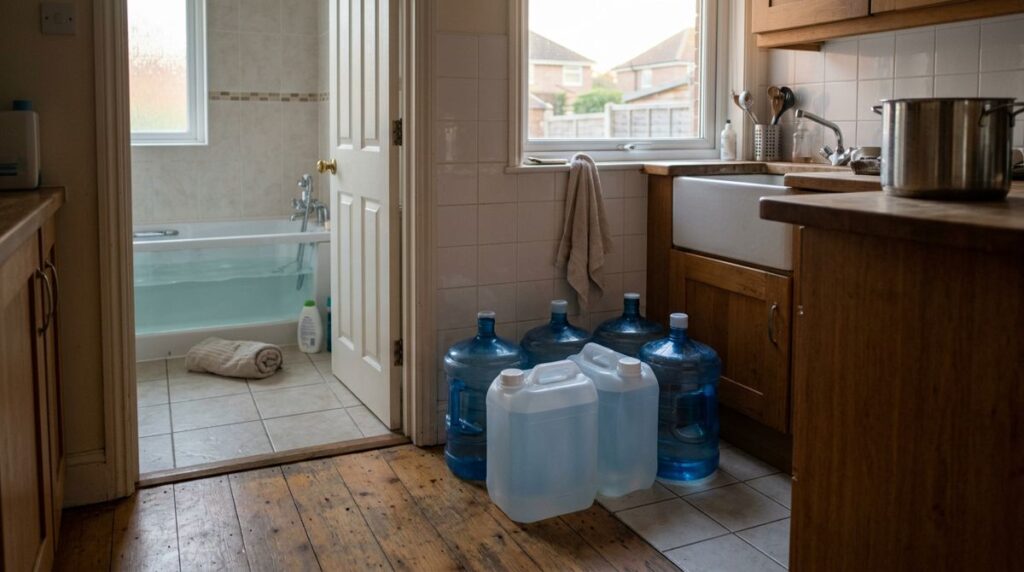
If your water comes from a well with an electric pump, chances are it stops the moment the power does, though you might squeeze a little more out of whatever’s left in the pressure tank, and even town water systems can have trouble keeping the pumps going, so it’s worth watching for any local drinking-water advisories. When there’s an outage in the forecast, fill some clean, food-safe containers with drinking water beforehand if you get the chance, and if you run water into the bathtub, that’ll do nicely for flushing.
Speaking of which, a regular gravity toilet usually has one flush left in the tank. As long as the drains are still doing their thing, you can top the tank back up to where the water normally sits using what you stored and then flush like you always would. Got a sewage ejector, a grinder pump or a pumped septic system? Then it’s another story. Those might not move wastewater at all with the power off, so go easy on the water until the electricity’s back.
Staying warm is mostly about huddling up. I mean everybody in the same room, dry layers piled on, all the blankets and sleeping bags you can find. Shut the doors to whatever rooms you’re not using, but keep exits and any ventilation you need clear. Please never try to heat the place with a barbecue, a camping stove or a gas oven, and if it gets so cold indoors that it isn’t safe anymore, get yourselves somewhere with heat while the roads are still okay to travel on.
Staying cool is more about keeping the sun out with your curtains or blinds, and opening the windows to get some air moving through when it’s cooler outside and the air’s safe to breathe (if there’s smoke or a lot of pollution, keep them shut). Downstairs is often cooler than upstairs, assuming it’s dry and safe down there. Keep sipping water all day. Fans help when it’s moderately hot, but in extreme heat they’re no substitute for air conditioning, so older adults, babies and anyone with certain health conditions should sort out access to somewhere air-conditioned early, not once it’s already unbearable.
When the Power Comes Back
When the lights pop back on, don’t go flipping every switch in the house. Let the supply settle down for a bit first, then turn stuff back on gradually (and yes, if your fridge or AC comes with a recommended restart delay, actually wait it out). Breakers are only worth touching if the panel’s dry and safe. One trips again right away? Leave it off and get it checked. Check what temperature the fridge and freezer are at pretty quickly too, because once they’ve cooled back down, the reading won’t tell you how warm the food got while it was off.
After that it’s the boring stuff, like resetting all the clocks and timers and checking that your important equipment, the alarms and the heating or cooling are working the way they should. Then recharge the power banks, lanterns and backup batteries before you put them away. Trust me, you don’t want the next outage to start with a drawer full of dead ones.
Quick Answers to Common Questions
Should I unplug electronics?
Yep, anything nonessential that you can get to safely, and switch off the cooking and heating appliances while you’re at it. Just leave one light on so you’ll notice when the power’s back.
Can I run an inverter off the car battery without the engine running?
You can, but you’ll be running down your starting battery, and nobody can give you a universal safe runtime for it, since that hinges on how old the battery is, the temperature, what shape it’s in, the load you’re putting on it and how much charge you’ll need left to restart the car.
How do I flush a toilet?
With a gravity toilet you can usually still flush, provided you’ve got water and the drains are still working, so you just refill the tank to its normal level with the water you stored. If your wastewater system depends on an electric pump, though, try to flush as little as possible until the power’s back.
How long does a deep freezer stay frozen?
If you leave the door shut, you’ve got roughly 48 hours with a full freezer and about 24 with a half-full one, and before you refreeze anything make sure there are still ice crystals in it or that it stayed at a safe temperature.
That’s really it for night one. Keep people safe, hang on to the cold food for as long as you can, and try not to create any new hazards while you’re waiting for the lights to come back on.